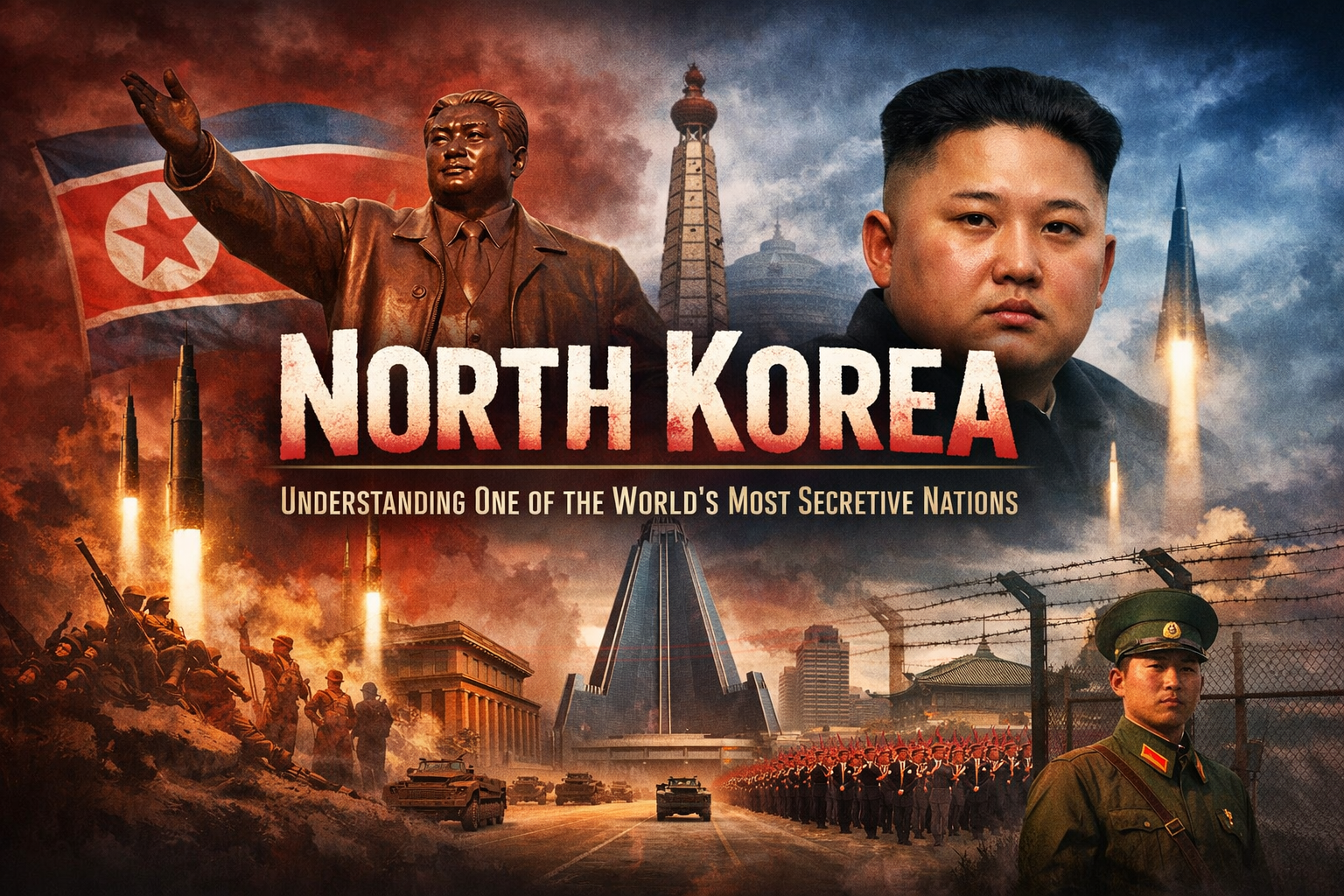
North Korea remains one of the most mysterious and tightly controlled countries in the world. Officially known as the Democratic People’s Republic of Korea (DPRK), the country sits on the northern half of the Korean Peninsula in East Asia. Despite being geographically close to global economic powers, North Korea has chosen a path of isolation that has shaped its politics, economy, and society for decades.
A Nation Divided by History
The story of modern North Korea begins at the end of World War II. After Japan’s defeat in 1945, the Korean Peninsula was divided along the 38th parallel. The northern part came under Soviet influence, while the south was supported by the United States. In 1948, two separate governments were formed: North Korea in the north and South Korea in the south.
Just two years later, the division turned into open conflict. The Korean War began in 1950 when North Korean forces crossed the border into South Korea. The war drew in major powers, including the United States and China. After three years of intense fighting, the conflict ended with an armistice rather than a peace treaty, leaving the peninsula technically still at war today.
Leadership and Political System
Since its founding, North Korea has been ruled by the same family dynasty. The country’s first leader was Kim Il-sung, who established a highly centralized government built around the idea of strong national independence. After his death in 1994, leadership passed to his son, Kim Jong-il. Today, the country is led by his grandson, Kim Jong-un.
The political system in North Korea is officially described as a socialist state, but in practice it operates under a highly centralized one-party structure dominated by the Workers’ Party of Korea. The government maintains strict control over media, travel, and information. Outside news and internet access are extremely limited for most citizens, which contributes to the country’s reputation as one of the most closed societies in the world.
Life Inside the Country
Daily life in North Korea can be very different from what people experience in most other nations. The government controls many aspects of society, including jobs, housing, and education. Citizens are often assigned work by the state, and movement within the country may require official permission.
Despite these restrictions, many North Koreans continue to build normal lives centered around family, community, and cultural traditions. Cities like Pyongyang showcase wide boulevards, large monuments, and government buildings that reflect the country’s political identity. The capital is also where many of the country’s cultural events and national celebrations take place.
However, outside the capital, economic conditions can be far more difficult. North Korea has struggled with food shortages and limited resources, partly due to natural disasters, economic isolation, and strict government policies.
Nuclear Program and Global Tensions
One of the biggest reasons North Korea often appears in international headlines is its nuclear weapons program. Over the past two decades, the country has conducted multiple nuclear tests and developed long-range missiles. These actions have led to serious concerns among neighboring countries and global powers.
The United Nations has imposed several rounds of sanctions aimed at limiting North Korea’s access to international trade and technology. The goal of these sanctions is to pressure the government into giving up its nuclear weapons program. However, negotiations between North Korea and other countries have produced limited long-term progress.
Meetings between North Korean leadership and foreign leaders occasionally raise hopes for diplomatic breakthroughs, but lasting agreements have proven difficult to achieve.
Culture, Identity, and National Pride
Although politics often dominate discussions about North Korea, the country also has a rich cultural heritage. Traditional Korean customs, music, dance, and art remain important parts of everyday life. State-sponsored performances and festivals often celebrate national history and leadership.
One of the most famous cultural events is the Mass Games, large performances featuring thousands of participants moving in perfect coordination. These events highlight the country’s emphasis on unity, discipline, and national pride.
Education also plays a major role in shaping national identity. Schools teach a strong sense of patriotism and emphasize the country’s independence and resilience in the face of outside pressure.
The Future of North Korea
Predicting the future of North Korea is challenging. The country’s leadership continues to prioritize military strength and political stability, while the international community pushes for reforms and denuclearization. At the same time, small changes inside the country—such as informal markets and limited economic experiments—suggest that gradual transformation could be possible.
North Korea’s relationship with the rest of the world remains complex. Some nations hope that diplomacy and engagement will lead to greater openness, while others focus on maintaining pressure through sanctions.
What is certain is that North Korea will continue to attract global attention. Its unique political system, strategic location, and nuclear ambitions make it one of the most closely watched countries in international affairs.
Conclusion
North Korea stands as one of the most unusual and tightly controlled states in the modern world. From its origins after World War II to its current role in global politics, the country has followed a path shaped by ideology, leadership, and isolation. Understanding North Korea requires looking beyond headlines and recognizing the historical forces and human realities that have shaped this complex nation.